Water Heater Replacement in Aurora, Colorado
When a tank is leaking, rusted through, or simply past its service life, we replace it with a properly sized, altitude-correct unit — permitted, inspected, and installed the same day in most cases.
- Same-day installs
- City of Aurora permits pulled
- Upfront written pricing
- Altitude-correct setup
- Old unit hauled away
- Licensed & insured
Start here
A water heater doesn't usually fail without warning — but by the time it's leaking onto a garage floor in Seven Hills or a utility closet in Del Mar Park, most homeowners aren't interested in warning signs anymore. They need a working water heater back in the house, installed correctly, and done in a way that passes inspection.
Aurora Water Heater Experts replaces tanks and tankless units across the city, from the 1950s and 60s brick bungalows near Colfax and Havana to the newest builds going up in Painted Prairie, The Aurora Highlands and Cross Creek. Every installation accounts for Aurora's elevation, the hardness of the municipal supply from the Prairie Waters Project, and the way your specific house was built.
This page walks through what actually fails, how to decide between repair and replacement, what a proper installation involves, and realistic cost ranges for the Denver metro — so you can make the call with real information instead of guesswork under pressure.
What water heater replacement in Aurora involves
Replacing a water heater is more than swapping one tank for another. It's matching the unit to your household's hot water demand, correcting for elevation, verifying gas and electrical capacity, and making sure the installation meets the City of Aurora's current plumbing and mechanical codes.
Because Aurora's housing stock ranges from Hoffman Heights ranches built in the Eisenhower era to Southlands and Tallyn's Reach homes finished in the last few years, no two replacements look quite the same. Older homes often have undersized gas lines, atmospheric venting through a masonry chimney, and combustion air openings that don't meet current code. Newer homes are more likely to have recirculating loops, tighter mechanical rooms, and higher baseline expectations for recovery speed.
We evaluate all of that during the estimate, then install a tank or tankless system sized and configured for your specific house — not a generic same-size replacement pulled off a truck.
Load calculation, not guesswork
We size the new unit to your household's peak hot water demand, fixture count, and any recirculating loop — not just the size of the unit you're replacing.
Altitude-correct setup
Gas input is derated and combustion air is sized to Aurora's roughly 5,470-foot elevation, per manufacturer specifications.
Full code compliance
Permit pulled, inspection scheduled, and expansion tank, drain pan, seismic strapping, and venting brought up to current Aurora Building Division standards.
Hard-water protection
Aurora Water's supply carries meaningful calcium and magnesium content; we build in sediment and scale protection appropriate to tank or tankless.
Water Heater Replacement Signs in Aurora
These are the failures that most often send Aurora homeowners looking for a replacement rather than a repair.
Tank leaking from the bottom
Once the glass lining inside a steel tank cracks, sediment-laden water corrodes the tank from the inside out. A leak at the base of the tank means the tank itself has failed — it cannot be patched or sealed.
Rust-colored water or rust at fittings
Rust in your hot water, or visible rust weeping around the tank seams, usually signals the anode rod is long spent and the tank's steel shell has started corroding.
Unit is 10-15+ years old
Standard tank water heaters are built for roughly a 10 to 12 year service life; Aurora's hard water often shortens that. Once a unit passes that mark, the cost-benefit of repairing versus replacing tips toward replacement.
Popping, rumbling, or banging sounds
Loud noises during heating cycles mean sediment has hardened at the bottom of the tank. Once buildup is this advanced, flushing rarely restores meaningful capacity or efficiency.
Constantly running out of hot water
If the household has grown, a bathroom was added, or a soaking tub went in during a remodel, the existing tank may simply be undersized for current demand — no amount of repair fixes that.
Rising energy bills with no other explanation
As tanks age, insulation degrades, elements or burners lose efficiency, and sediment forces the unit to work harder to reach set temperature — showing up directly on the gas or electric bill.
What your water heater is trying to tell you
Some signs mean it's time to plan a replacement. Others mean stop what you're doing and call now.
- Standing water or dampness at the base of the tank
- Rust-colored or metallic-tasting hot water
- Rumbling, popping, or cracking sounds during the heating cycle
- Water heater is original to a home built before the mid-2000s
- Pilot light won't stay lit or cycles repeatedly
- Visible corrosion on the tank, fittings, or T&P valve
- Inconsistent water temperature that won't respond to adjustment
- A sulfur or rotten-egg smell from hot water taps
Why Water Heaters Fail in Aurora Homes
Understanding why tanks fail in Aurora specifically helps explain why the fix is a full replacement rather than a patch.
Hard water from the Prairie Waters system
Aurora Water blends South Platte, Colorado River and Arkansas River basin sources through the Peter D. Binney Purification Facility. The finished water is safe and clean, but its calcium and magnesium content builds sediment inside tanks and scales tankless heat exchangers faster than soft water would.
Age outpacing manufacturer design life
Most tank water heaters are engineered for a 10 to 12 year lifespan. Beyond that point, internal corrosion accelerates quickly, and the cost of repeated repairs stacks up against a full replacement.
Cold winter inlet water stressing the system
Aurora's municipal water can drop into the low 40s°F in winter, forcing the unit to work harder to reach set temperature and shortening element and burner life over the years.
Undersized original installation
Many homes in older Aurora neighborhoods were built with a 30-40 gallon tank sized for the original owners. Decades of ownership changes and additions later, the tank hasn't kept pace with actual household demand.
Altitude-related combustion issues
A gas water heater installed without correcting for Aurora's roughly 5,470-foot elevation can run inefficiently for years, accelerating wear on burners and heat exchangers well ahead of schedule.
Deferred maintenance
A tank that's never been flushed accumulates sediment layer by layer. Once that buildup insulates the bottom of the tank from the burner or lower element, both efficiency and tank life drop sharply.
Water Heater Replacement Options
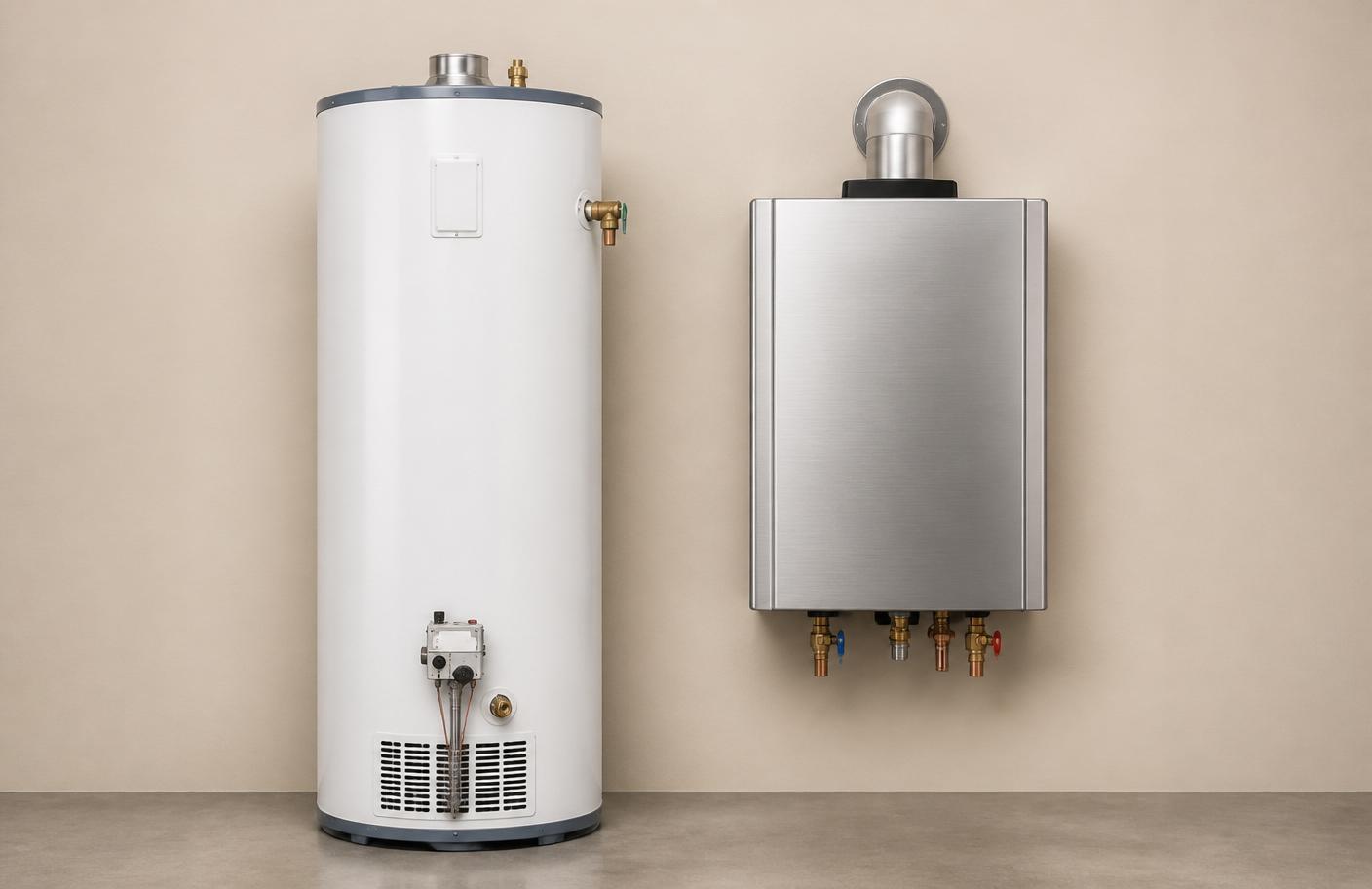
We install the option that actually fits your household and your home's mechanical setup — not a one-size answer.
Standard gas or electric tank replacement
A direct, code-compliant swap for households whose existing tank size and fuel type still make sense, with expansion tank, drain pan, and strapping brought up to current code.
Upsized tank for growing households
Moving from a 40 to a 50 or 75 gallon tank for households that have outgrown the original unit — verified against gas line and venting capacity before installation.
Tankless conversion
Endless hot water and a smaller footprint for homes ready to move off a tank entirely, with proper gas line upsizing, venting, and a scale-protection filter built in from day one.
Hybrid heat pump water heater
A high-efficiency electric option for well-ventilated garages and utility rooms, especially useful for homeowners looking to cut electric water heating costs long term.
Recirculating loop integration
For newer far-east Aurora homes in Southlands, Blackstone, and Murphy Creek that already run a hot water recirculation system, we install and configure units compatible with the existing loop and pump.
Relocation and code upgrades
When an old unit sits somewhere that no longer meets code — inadequate combustion air, missing drain pan, no seismic strapping — we correct the installation as part of the replacement, not as a separate change order later.
Should you repair or replace?
We'll always tell you honestly when a repair still makes sense — replacement isn't the answer to every service call.
Repair usually makes sense when
- The unit is under 6-7 years old
- The failure is a single part: thermocouple, heating element, thermostat, or valve
- The tank itself shows no rust, corrosion, or leaking
- The repair cost is well under half the price of a new installation
- The unit is correctly sized for current household demand
Replacement usually makes sense when
- The tank is actively leaking or shows rust at the seams
- The unit is past or approaching 10-12 years old
- You've had more than one repair in the past 1-2 years
- The household has outgrown the tank's capacity
- You want the efficiency and space savings of going tankless
Our rule of thumb
Our Water Heater Installation Process
Here's what a scheduled replacement looks like from the first phone call to final inspection.
- 1
Phone assessment
We ask about the unit's age, fuel type, symptoms, and household size to bring the right equipment on the first visit.
- 2
In-home evaluation
A technician inspects the existing unit, gas or electrical supply, venting, water pressure, and available space before recommending options.
- 3
Written, upfront quote
You get a clear price for the recommended tank or tankless system before any work begins — no surprise line items afterward.
- 4
Permit filed
We file the required permit with the City of Aurora Building Division and schedule the follow-up inspection.
- 5
Old unit removed
The existing water heater is drained, disconnected, and hauled away for recycling.
- 6
New unit installed
The replacement is set, connected, and configured — including altitude-correct gas setup, updated venting, expansion tank, and strapping as needed.
- 7
Testing and walkthrough
We test for leaks, verify temperature and pressure relief operation, and walk you through the new unit's settings and maintenance needs.
- 8
Inspection scheduled
We coordinate the City of Aurora inspection so the installation is fully signed off and on record.
Water Heater Replacement Cost in Aurora
These are realistic Denver-metro ranges. Exact pricing depends on unit size, fuel type, and what your specific installation requires.
| Scope of work | Typical range |
|---|---|
Standard 40-50 gallon gas tank replacement Like-for-like swap with permit, disposal, and code-required upgrades included. | $1,800 - $3,200 |
50-75 gallon gas tank, upsized For households needing more recovery capacity than the existing tank provides. | $2,200 - $3,800 |
Electric tank replacement Includes verifying electrical circuit capacity and code-compliant wiring connections. | $1,600 - $2,900 |
Tankless conversion (gas) Includes gas line upsizing, venting changes, and a scale-protection filtration setup. | $3,800 - $7,500 |
Hybrid heat pump water heater Requires adequate air volume in the install space; higher upfront cost, lower operating cost. | $3,200 - $5,500 |
Relocation or major code correction For moving the unit or bringing an old installation up to current venting and combustion-air code. | $800 - $2,500 additional |
Why the range is a range
- Every quote includes the City of Aurora permit and inspection coordination.
- Removal and recycling of the old unit is included at no extra charge.
- Financing with same-day approval is available on any installation.
- Prices reflect Denver-metro market rates as of this year and are confirmed in writing before work begins.
Benefits of a New Water Heater
A correctly installed replacement pays off in more than just hot water.
Lower failure risk
A new tank or tankless unit removes the leak, rust, and shutdown risk that comes with aging equipment.
Better efficiency
Modern units, properly derated for altitude, recover faster and use less energy than a decade-old tank.
Code compliance
Permitted, inspected installations protect your home's resale value and insurance standing.
Right-sized hot water
No more running out mid-shower or overpaying to heat far more water than the household uses.
Maintaining Your New Water Heater
A new installation lasts longer with a small amount of consistent upkeep — especially on Aurora's hard water.
Because Aurora Water's supply carries meaningful mineral content, sediment builds up inside a tank faster here than it would on soft water. An annual flush keeps sediment from insulating the burner or lower element and shortening the unit's life.
Tankless units need periodic descaling of the heat exchanger — typically once a year — to keep flow rate and efficiency where they should be and to keep the manufacturer's warranty valid.
We offer a maintenance plan that covers annual flushing, anode rod inspection, T&P valve testing, and a full system check, so small issues get caught before they turn into another replacement call.
- Flush the tank annually to clear sediment
- Inspect and replace the anode rod every 3-5 years
- Test the T&P valve once a year
- Descale tankless heat exchangers annually
- Check the expansion tank's precharge pressure yearly
- Watch for rust, moisture, or corrosion at fittings
Aurora Water Heater Replacement Questions
Where to go next
Water Heater Repair
Not sure replacement is necessary yet? See what we can typically fix first.
Read moreTankless Water Heaters
Compare tankless against a traditional tank for your Aurora home.
Read moreEmergency Water Heater Repair
Active leak or no hot water right now? Get same-day emergency service.
Read moreWater Heater Maintenance
Extend the life of your new installation with an annual maintenance plan.
Read moreReady for a water heater that just works?
Call for a same-day estimate or schedule online. Upfront pricing, permitted installation, and a technician who explains every option before you decide.