Water Heater Maintenance that Actually Extends the Life of Your Unit
Annual flushing, anode rod service, and altitude-aware tune-ups keep tank and tankless water heaters running longer across Aurora's hard-water supply — from 1960s ranches near Colfax to recirculating systems in Painted Prairie.
- Same-week scheduling
- Upfront flat pricing
- Licensed local technicians
- Anode & flush specialists
- Gas & electric units
- Tankless descaling
Start here
Most Aurora homeowners only think about their water heater when it stops working. By then, the sediment that's been settling in the bottom of the tank for years has already done its damage — insulating the burner or lower element, corroding the tank wall once the anode rod is spent, and cutting hot water capacity without anyone noticing the gradual decline.
Aurora Water delivers a clean, well-treated supply from the South Platte, Colorado River, and Arkansas River basins through the Prairie Waters Project and the Peter D. Binney Purification Facility. That's good news for taste and safety, but the water is still moderately hard by the time it reaches homes in Hoffman Heights, Village East, or Murphy Creek, and hardness plus winter inlet temperatures in the low 40s means a tank works harder and accumulates scale faster than in a soft-water region.
Regular maintenance is the cheapest insurance available for a water heater. A $120 to $190 flush once a year, paired with anode rod checks every two to three years, routinely adds three to five years of service life and prevents the two failures that cause the most damage: a stuck pressure relief valve and a rusted-through tank that floods a basement or utility closet.
What Water Heater Maintenance Covers in Aurora
A proper maintenance visit is more than draining a few gallons out of the tank. It's a systematic check of every component that fails over time, done in the order that actually catches problems before they become emergencies.
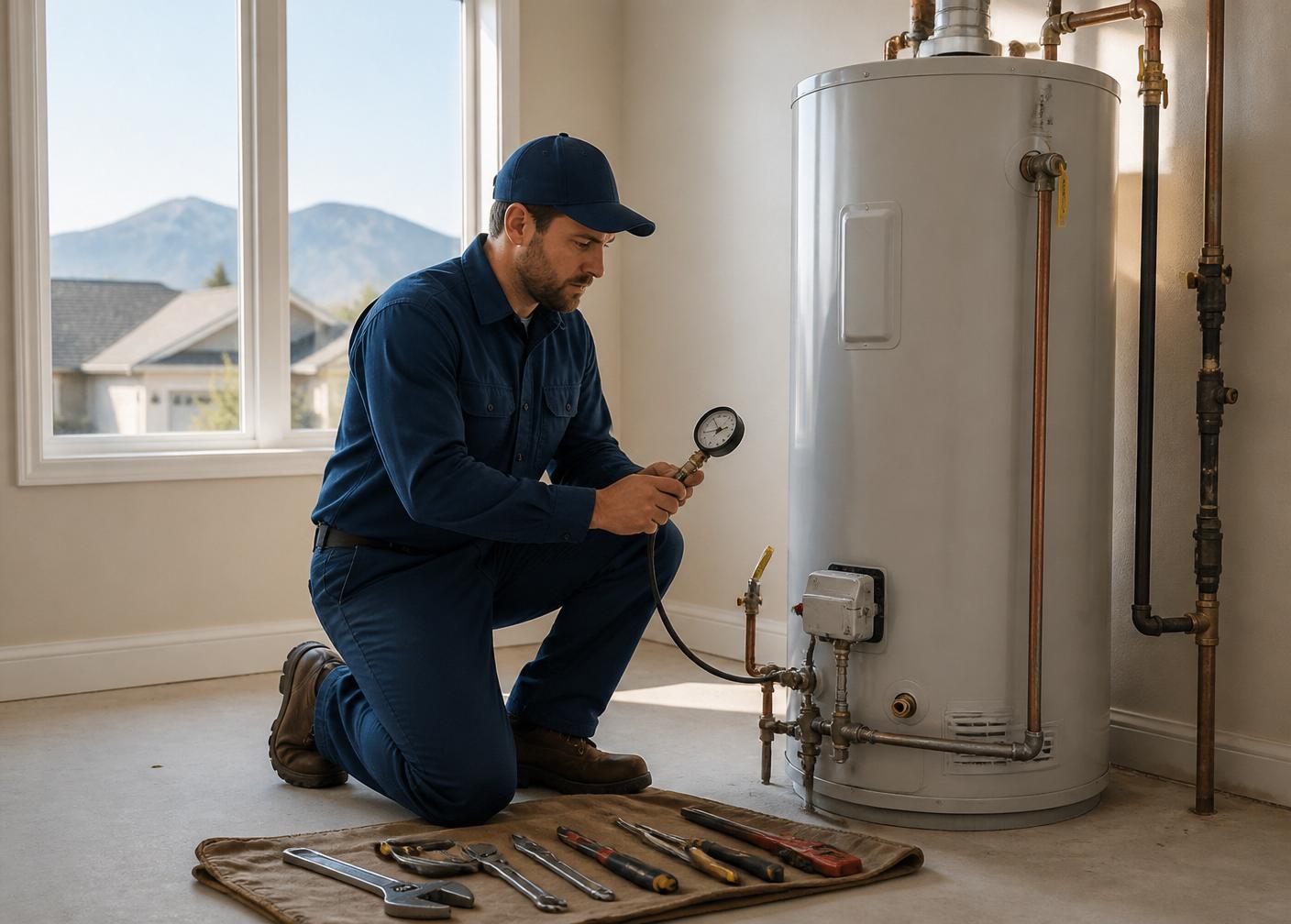
For tank units, that means a full flush to remove sediment, an anode rod inspection since that sacrificial rod is what protects the tank steel from corrosion, and a function test of the temperature and pressure relief valve, which is the single most important safety component on the unit. On gas models, we also check burner combustion and venting, since Aurora's 5,470-foot elevation means appliances need proper derating and adequate combustion air to burn efficiently and safely.
For tankless units, maintenance centers on descaling the heat exchanger with a vinegar or manufacturer-approved solution to remove mineral buildup, along with an inlet filter cleaning and a check of the venting and combustion air intake.
Sediment flush
Full tank drain and flush to remove mineral sediment that insulates the burner or elements and reduces hot water capacity.
Anode rod inspection
Check the sacrificial anode rod's condition and replace it before the tank steel itself starts corroding.
Safety valve test
Verify the temperature and pressure relief valve opens and reseats properly, the most important safety check on the unit.
Altitude-correct combustion
Confirm gas burners are properly derated and combustion air is adequate for Aurora's 5,470-foot elevation.
What actually goes wrong
These are the issues we find most often on Aurora maintenance visits, roughly in order of frequency.
Sediment buildup at the tank bottom
Mineral sediment from Aurora's moderately hard water settles at the bottom of the tank, insulating the burner or lower element and reducing usable hot water volume over time.
Depleted anode rod
The sacrificial anode rod corrodes so the tank steel doesn't have to. Once it's fully consumed, usually after three to five years, the tank itself starts rusting from the inside.
Slow-draining or clogged drain valve
Plastic drain valves clog with sediment over the years, making a proper flush difficult and sometimes forcing a valve replacement mid-service.
Failing temperature and pressure relief valve
The T&P valve can seize, drip continuously, or fail to open under pressure — any of which is a genuine safety concern rather than a minor annoyance.
Scale on tankless heat exchangers
In tankless units, mineral scale coats the heat exchanger surface, reducing flow rate and hot water output, and eventually triggering error codes if left unaddressed for several years.
Improper combustion at altitude
Gas units installed without proper altitude derating or with restricted combustion air run inefficiently and can develop sooting on the burner assembly over time.
What your water heater is trying to tell you
A water heater usually signals trouble well before it fails outright. Catching these early is what maintenance is designed to prevent.
- Popping, rumbling, or crackling sounds during heating cycles
- Noticeably less hot water than the unit used to provide
- Rusty or discolored water from the hot tap only
- A rotten-egg smell in hot water (often the anode rod reacting with sulfur bacteria)
- Longer recovery time between showers or dishwasher and laundry cycles
- Visible moisture, rust, or mineral crust around the base of the tank
- A tankless unit throwing flow or temperature error codes
- The unit is 6+ years old and has never had a professional flush
Why it happened in the first place
Understanding why these issues happen helps explain why annual maintenance matters more in Aurora than homeowners moving from soft-water regions might expect.
Moderately hard treated water
Aurora Water's Prairie Waters supply is clean and safe but carries enough dissolved minerals to leave sediment and scale behind as water heats, especially in older 1950s-70s homes without a softener.
Cold winter inlet temperatures
Groundwater and municipal supply temperatures drop into the low 40s°F in winter, meaning the unit works through a larger temperature rise and accumulates scale faster during the coldest months.
Skipped or infrequent flushing
The single biggest driver of premature failure we see is simply going five, eight, or ten years without a flush, letting sediment compact into a layer that's difficult to remove even with a professional flush.
Original equipment left unchecked
Homes in Hoffman Heights, Del Mar Park, and other established neighborhoods sometimes still have anode rods and valves original to a 10+ year-old unit that were never inspected.
Recirculating loops without service
Newer builds in Painted Prairie, Tallyn's Reach, and The Aurora Highlands often include recirculating hot water loops, and the pump and check valve need periodic attention that's easy to overlook.
How we fix it
What we do at a maintenance visit to head off each of these issues.
Full tank flush
Complete drain and flush cycle to remove settled sediment and restore full tank capacity and heating efficiency.
Anode rod replacement
Inspect and replace the anode rod on the schedule that matches your water chemistry, typically every two to three years in Aurora.
Valve testing and replacement
Function-test the T&P valve and drain valve, replacing either if they're seized, dripping, or clogged with sediment.
Tankless descaling
Circulate a descaling solution through the heat exchanger to dissolve mineral buildup and restore flow rate and output temperature.
Combustion and venting check
Confirm gas burners are properly tuned for Aurora's elevation and venting is clear and correctly sloped.
Recirculation pump service
Inspect and, if needed, service the recirculation pump and check valve on newer homes with a hot water loop.
What the appointment looks like
What to expect when you schedule a maintenance visit.
- 1
Initial inspection
We check the unit's age, condition, venting, and any visible signs of corrosion or leaking before starting work.
- 2
Shutdown and drain setup
Power or gas is shut off safely, and a hose is connected to the drain valve to begin the flush.
- 3
Full flush
The tank is drained and flushed with fresh water until it runs clear, which can take several passes on a long-neglected unit.
- 4
Anode and valve check
We pull the anode rod to check its condition and test the T&P and drain valves for proper function.
- 5
Combustion and venting review
On gas units, we verify burner operation and venting are appropriate for Aurora's altitude and current conditions.
- 6
Restart and walkthrough
We restore power or gas, confirm proper operation, and walk you through what we found and what to expect before the next visit.
What Aurora homeowners actually pay
Typical Aurora pricing for maintenance work, in 2024 metro-area dollars.
| Scope of work | Typical range |
|---|---|
Standard tank flush & inspection Includes full drain, flush, and a visual check of valves and connections. | $120 – $190 |
Anode rod replacement Cost varies with access; some 1960s installs need extra clearance work. | $110 – $180 |
Full tune-up (flush + anode + combustion check) Recommended every year for gas units, especially those over 5 years old. | $180 – $260 |
Tankless descaling & filter service Annual service to protect the heat exchanger from mineral scale buildup. | $150 – $250 |
T&P or drain valve replacement Common add-on when a valve is found seized or clogged during a flush. | $90 – $160 |
Recirculation pump service For newer homes with a recirculating hot water loop in Painted Prairie or Tallyn's Reach. | $140 – $220 |
Why the range is a range
- Prices reflect typical Aurora metro conditions; tight utility closets in older homes can add labor time.
- Bundling a flush and anode check in the same visit is almost always cheaper than two separate calls.
- We provide a written estimate before starting any work beyond the scope you approved.
What you get out of it
What regular maintenance actually buys you.
Longer equipment life
A well-maintained tank commonly reaches 12-15 years versus 8-10 years for a neglected unit.
Lower utility bills
A clean tank and heat exchanger transfer heat more efficiently, reducing the energy needed to maintain temperature.
Fewer emergency calls
Catching a failing valve or spent anode during a routine visit avoids a middle-of-the-night flood or cold shower.
Consistent hot water
Removing sediment restores full tank capacity so hot water lasts through a full shower or load of laundry again.
Keeping it from happening again
What we recommend homeowners do between professional visits.
Between annual professional visits, there are a few simple checks any Aurora homeowner can do that catch problems early without any special tools.
Once a month, glance at the base of the water heater for moisture, rust, or mineral crust, and check that the area around the unit is clear for proper combustion air if it's a gas model. Twice a year, test the T&P valve's lever briefly to confirm it isn't seized, and listen for unusual sounds during a normal heating cycle.
If you notice a gradual drop in hot water volume or discolored water at the hot tap, that's worth a call before it becomes a bigger repair. These small habits, paired with an annual professional flush and periodic anode check, are what keep a water heater running reliably well past its expected lifespan.
- Check for moisture or rust at the tank base monthly
- Confirm the area around a gas unit is clear for combustion air
- Test the T&P valve lever briefly every six months
- Watch for a gradual drop in hot water capacity
- Note any new noises during heating cycles
- Schedule a professional flush annually
- Have the anode rod checked every 2-3 years
- Descale a tankless unit annually
Aurora homeowner questions
Where to go next
Water Heater Repair
Fast diagnosis and repair for leaks, no hot water, and strange noises across Aurora.
Read moreWater Heater Replacement
Straight talk on when replacement beats repair, plus upfront installed pricing.
Read moreTankless Water Heaters
Endless hot water and space savings for Aurora homes, installed and serviced right.
Read moreEmergency Water Heater Repair
24/7 response for active leaks, no heat, and failed valves anywhere in Aurora.
Read moreWater Heater Maintenance
Annual flushing and anode service that extends the life of tank and tankless units.
Read moreProtect Your Water Heater Before It Fails
Schedule an annual flush and inspection with an Aurora water heater specialist. Straightforward pricing, no upsell pressure, and technicians who know exactly what Aurora's water does to a tank over time.