Water heater repair that gets your hot water back the same day
From Hoffman Heights ranches to Southlands two-stories, Aurora homes lose hot water for a handful of predictable reasons — and most of them are fixable in a single visit. We diagnose on-site, quote a flat price, and repair gas, electric, and tankless units across every Aurora ZIP code.
- Same-day appointments
- Upfront flat pricing
- Licensed & insured techs
- All brands, gas & electric
- Permit handling included
- After-hours emergency line
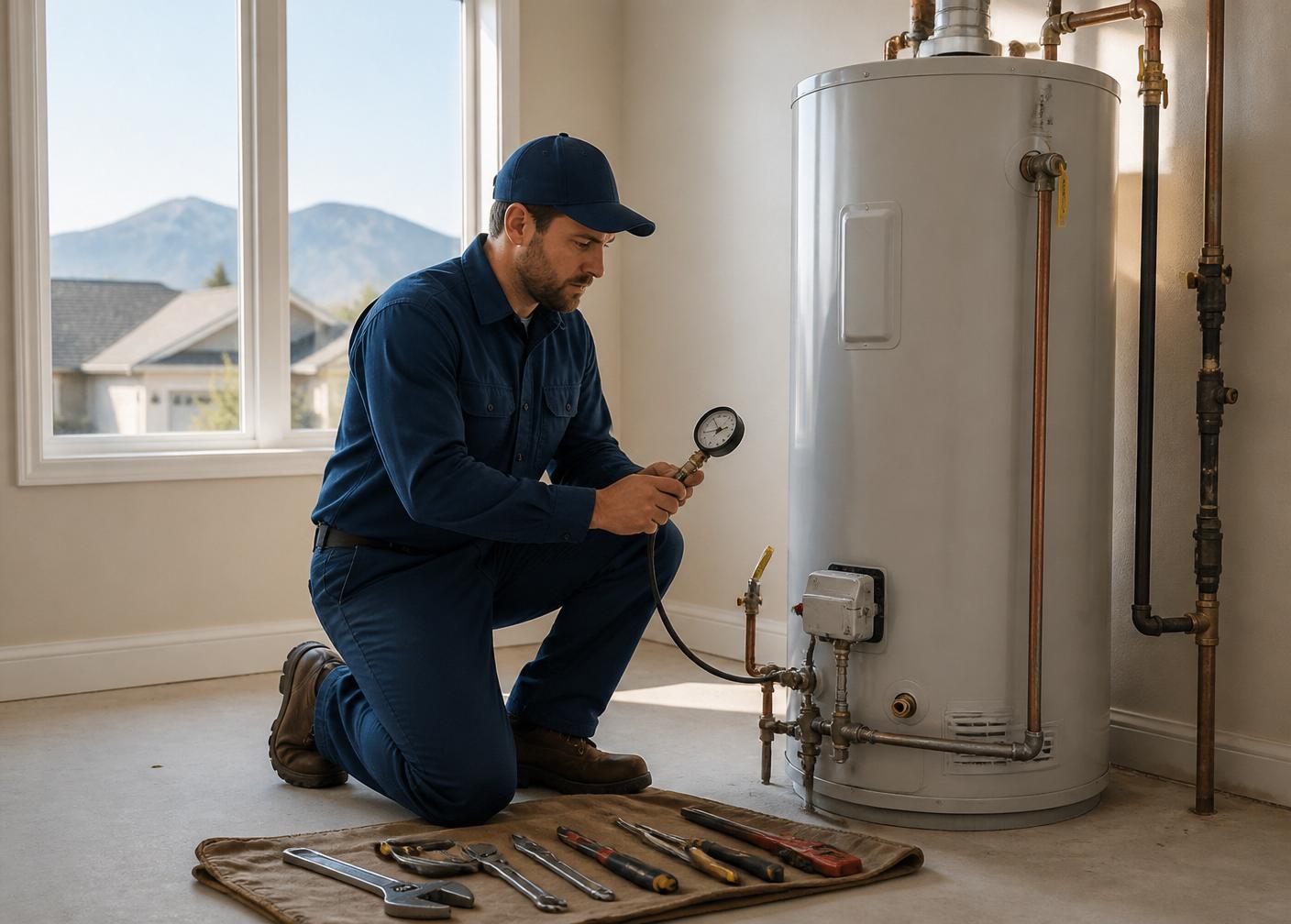
Water Heater Repair in Aurora, CO
A water heater rarely fails without warning. Rust-colored water, a rotten-egg smell, a rumbling tank, or a pilot light that won't stay lit are all signals that show up days or weeks before a full breakdown — and in most cases, catching the problem early means a repair instead of a full replacement.
Aurora's water heaters face a specific set of local conditions. Aurora Water delivers a clean but hard supply, drawn through the Prairie Waters Project from the South Platte, Colorado River, and Arkansas River basins and treated at the Peter D. Binney Purification Facility. That hardness — meaningful calcium and magnesium content — builds sediment inside tanks faster than in many parts of the country, and it's the single biggest driver of the repair calls we run across the city.
The other factor is elevation. At roughly 5,470 feet, gas water heaters need properly derated burners and enough combustion air to fire cleanly and consistently. Homes built in the 1950s and '60s near Colfax and Havana, in Hoffman Heights, Del Mar Park and Highline Villages, often have tighter utility closets that weren't designed with today's venting standards in mind — which shows up as pilot lights that won't hold or burners that soot.
Whatever the cause, our approach is the same: diagnose the actual failure, explain it in plain terms, and give you a fixed price for the fix before we touch anything.
What our repair service covers
We repair both tank and tankless water heaters, gas and electric, in homes across Aurora — from older ranches near Del Mar Park to new-construction two-stories in Painted Prairie and Beacon Point.
Every repair call starts with a full diagnostic: we check the tank, venting, gas supply or electrical circuit, thermostat and control settings, and water pressure before recommending a fix. If a part needs to be replaced, we carry common components on the truck for most major brands, which is why the majority of repairs finish in a single visit.
We also flag anything that isn't an emergency today but is worth watching — a slow leak at a fitting, early sediment buildup, or an anode rod nearing the end of its life — so you can plan ahead instead of getting surprised.
Gas & electric tanks
Thermocouples, igniters, gas valves, heating elements, thermostats, and dip tubes for standard tank-style units.
Tankless systems
Descaling, flow sensor and igniter diagnostics, error code troubleshooting, and flushing service for on-demand units.
Leak diagnosis
Pinpointing whether a leak is from a fitting, the T&P valve, or the tank itself — and whether it's repairable or a replacement flag.
Permit-compliant work
Any repair that touches venting, gas line sizing, or the unit's location is handled to City of Aurora Building Division standards.
Common Water Heater Problems in Aurora Homes
These are the failures we see most often on repair calls across Aurora's neighborhoods, from 1950s bungalows to 2020s far-east builds.
No hot water at all
On gas units, usually a failed thermocouple, igniter, or gas control valve. On electric units, a tripped high-limit switch or a failed upper heating element.
Lukewarm or inconsistent water
Often sediment insulating the burner or lower element from the water, or a failing thermostat that's no longer reading temperature accurately.
Rumbling, popping, or banging sounds
A classic sign of sediment buildup on the tank floor — water trapped under the sediment layer boils and pops as it heats, common with Aurora's hard water supply.
Water pooling around the base
Could be a loose fitting, a failing T&P valve, condensation, or — on older tanks — a corroded tank shell that's beginning to leak.
Pilot light won't stay lit
Often a dirty or failing thermocouple, a draft issue in the venting, or insufficient combustion air — more common in tight, older utility closets.
Discolored or metallic-tasting water
Usually a sign the anode rod is depleted and the tank has started to corrode internally, or sediment has built up enough to affect water quality.
Tripped breaker on an electric unit
Typically a shorted heating element or a failing thermostat drawing excess current — an electrical issue that needs prompt diagnosis to avoid damage.
Tankless error codes
Scale buildup, a restricted flow sensor, venting issues, or an ignition fault — increasingly common in newer Southlands and Tallyn's Reach homes with tankless installs.
Slow recovery time
The tank takes far longer than it used to to reheat a full tank of water — often sediment buildup or a failing element/burner losing efficiency.
Warning signs your water heater needs repair
Some symptoms mean 'schedule a repair this week.' Others mean 'turn it off and call now.' Here's how to tell the difference.
- Water heater is more than 10 years old and showing any of the symptoms above
- Rust-colored water coming from hot taps throughout the house
- A sulfur or rotten-egg smell in hot water
- Rumbling, popping, or knocking sounds from the tank
- Pilot light that won't stay lit or keeps going out
- Noticeably slower recovery time between hot showers
- A breaker that keeps tripping when the water heater runs
- Visible corrosion or rust on the tank exterior or fittings
- Water pooling anywhere near the base of the unit
- Tankless unit displaying a recurring error code
Why Water Heaters Fail in Aurora
Repairs almost always trace back to one of a handful of root causes — most of them tied directly to Aurora's water supply, elevation, or the age of the housing stock.
Hard water and sediment
Aurora Water's supply carries meaningful calcium and magnesium content. Over time it settles as sediment inside the tank, insulating heating elements and burners and driving most of the lukewarm-water and rumbling-tank calls we run.
Altitude and combustion air
At roughly 5,470 feet, gas appliances need adequately derated burners and enough combustion air to fire cleanly. Tight utility closets in older homes can starve a burner of air, causing pilot and ignition problems.
Cold winter inlet water
Winter supply temperatures drop into the low 40s°F, which pushes tanks and elements harder for longer recovery periods and can expose a marginal component that was already close to failing.
Depleted anode rod
The sacrificial anode rod protects the tank from corrosion. Once it's consumed — faster in hard water areas — the tank itself starts to corrode, leading to discolored water and eventual leaks.
Age of the unit
Standard tank water heaters last roughly 8–12 years. Homes in Hoffman Heights, Del Mar Park, and other 1950s–60s neighborhoods often still have original or long-overdue units nearing or past that window.
Lack of routine flushing
A tank that's never been flushed accumulates sediment layer by layer for years. By the time symptoms show up, the buildup is often significant enough to need more than a simple flush to resolve.
Water Heater Repair Solutions We Provide
Once we've diagnosed the issue, most repairs fall into one of these categories.
Component replacement
Thermocouples, igniters, gas control valves, heating elements, and thermostats — swapped with OEM or equivalent parts and tested before we leave.
Tank flush & sediment removal
Clearing sediment buildup that's causing rumbling, reduced capacity, or lukewarm water — often paired with recommending an annual flush going forward.
Anode rod replacement
Swapping a depleted anode rod to stop active corrosion and extend the tank's remaining service life, especially valuable given local water hardness.
Venting & combustion air correction
Adjusting or correcting venting and combustion air supply so a gas unit fires reliably at Aurora's elevation.
Tankless descaling & sensor service
Flushing scale from the heat exchanger and servicing flow sensors or igniters to resolve error codes and restore proper flow.
Leak repair or containment
Tightening or replacing fittings and valves for repairable leaks — or advising honestly when the leak means the tank itself is failing.
Repair vs. replace: how we help you decide
Not every failure is a repair, and not every old water heater needs to go. Here's the honest breakdown we walk every customer through.
Repair usually makes sense when...
- The unit is under 8–10 years old
- The failure is a single component — thermocouple, element, thermostat, igniter
- The tank itself shows no signs of corrosion or leaking
- This is the first service call on the unit
- The repair cost is well under half the cost of full replacement
Replacement usually makes sense when...
- The tank is leaking from the tank body itself, not a fitting
- The unit is 10–12+ years old and this is a repeat service call
- Repair costs are approaching half the price of a new unit
- You're seeing rust-colored water and confirmed internal corrosion
- You want to upsize capacity or switch to tankless for a growing household
Our rule of thumb
Our Water Heater Repair Process
Here's what to expect from the call to the finished repair.
- 1
Call or book online
Tell us the symptoms — no hot water, strange noise, a leak — and we'll get a technician scheduled, often same-day.
- 2
On-site diagnostic
We inspect the tank, venting or wiring, gas or electrical supply, and controls to identify the actual root cause, not just the symptom.
- 3
Flat-price quote
You get one price for the repair before any work begins — no hourly rate, no surprise add-ons once we're inside the unit.
- 4
Repair & testing
We complete the repair, then run the unit through a full heating and safety cycle to confirm the fix holds.
- 5
Walkthrough & recommendations
We explain what failed, why, and flag anything worth monitoring — like an aging anode rod or a tank approaching replacement age.
- 6
Permit filing if applicable
If the repair touches venting, gas sizing, or location, we file the required City of Aurora paperwork so the work is fully compliant.
Water Heater Repair Cost in Aurora
Aurora repair costs vary by part and access, but most jobs fall into predictable ranges.
| Scope of work | Typical range |
|---|---|
Thermocouple or igniter replacement Common fix for a pilot light that won't hold or a gas unit that won't ignite. | $175 – $325 |
Heating element or thermostat (electric) Covers diagnosis, part, and labor for one or both elements/thermostats. | $200 – $400 |
Gas control valve replacement Needed when the valve itself fails to regulate gas flow or modulate properly. | $350 – $650 |
Tank flush & sediment removal Recommended annually in Aurora given local water hardness. | $150 – $275 |
Anode rod replacement Access can be tight on some tank models, affecting labor time. | $175 – $300 |
Tankless descaling & sensor service Depends on scale severity and whether a sensor or igniter also needs replacement. | $250 – $450 |
Emergency / after-hours service call Added to standard repair pricing for evenings, weekends, or urgent same-day dispatch. | +$75 – $150 |
Why the range is a range
- Every quote is flat-rate and given in writing before work begins.
- Diagnostic fees are waived when you move forward with the repair.
- We tell you upfront if a repair isn't cost-effective compared to replacement.
- Parts warranties vary by manufacturer; we always confirm coverage before you pay for a part still under warranty.
Benefits of Professional Water Heater Repair
Why Aurora homeowners call us for repairs instead of a general handyman or a big-box installer.
Water heaters only
This is the only system we work on, which means faster, more accurate diagnostics than a general plumber juggling multiple trades.
Flat, upfront pricing
You approve one price before we start — never an hourly rate that climbs as the job goes.
Same-day availability
Most repair calls are scheduled and completed the same day, including our after-hours emergency line.
Local knowledge
We know how Aurora's water hardness, elevation, and housing stock affect water heaters — and we diagnose with that context in mind.
Water Heater Maintenance to Prevent Future Repairs
The single best way to avoid repeat repair calls is routine maintenance tuned to Aurora's water conditions.
Because Aurora Water's supply carries meaningful hardness, sediment is the leading cause of premature water heater failure across the city. An annual flush prevents most of the lukewarm-water and rumbling-tank issues we see, and it's inexpensive compared to the repairs that build up sediment causes over time.
Anode rods should be checked every 2–3 years and replaced when significantly depleted, since hard water accelerates their consumption. T&P valves, gas connections, and venting are worth a professional look on the same schedule, especially in older Aurora homes with tighter utility closets.
If you'd rather not track this yourself, our maintenance plan bundles the annual flush, anode inspection, and a full safety check into one visit, and gives you priority scheduling if something does go wrong between visits.
- Flush the tank annually to clear sediment
- Inspect and replace the anode rod every 2–3 years
- Test the T&P valve annually
- Check gas venting and combustion air clearance
- Inspect visible fittings and connections for corrosion or leaks
- Confirm thermostat is set to a safe, efficient 120°F
- Descale tankless units per manufacturer schedule
Water Heater Repair FAQs
Related Water Heater Services in Aurora
Water Heater Replacement in Aurora
When a repair no longer makes sense, see pricing, unit options, and what a full replacement involves.
Read moreTankless Water Heater Installation & Repair
Explore on-demand systems, ideal for newer Aurora homes with recirculating loops or growing households.
Read moreEmergency Water Heater Repair
Active leak, no hot water, or a unit showing signs of imminent failure? Get same-day emergency dispatch.
Read moreWater Heater Maintenance Plans
Annual flushing and inspection service designed around Aurora's hard water supply to prevent repeat repairs.
Read moreGet your hot water back — today
Call (720) 644-8755 for a same-day diagnostic and a flat-price repair quote, or request an estimate online and we'll confirm a time that works for your Aurora home.