Tankless Water Heaters, Sized for Aurora
Endless hot water, sized correctly for 5,470 feet of elevation and Colorado winter inlet temperatures — not a sea-level spec sheet. We handle sizing, gas and vent upgrades, City of Aurora permitting and annual descaling in one relationship.
- Altitude-correct BTU sizing
- Permit & inspection handled
- Gas line resizing included
- Hard-water descaling plans
- 18–20 year service life
- Same-week installation
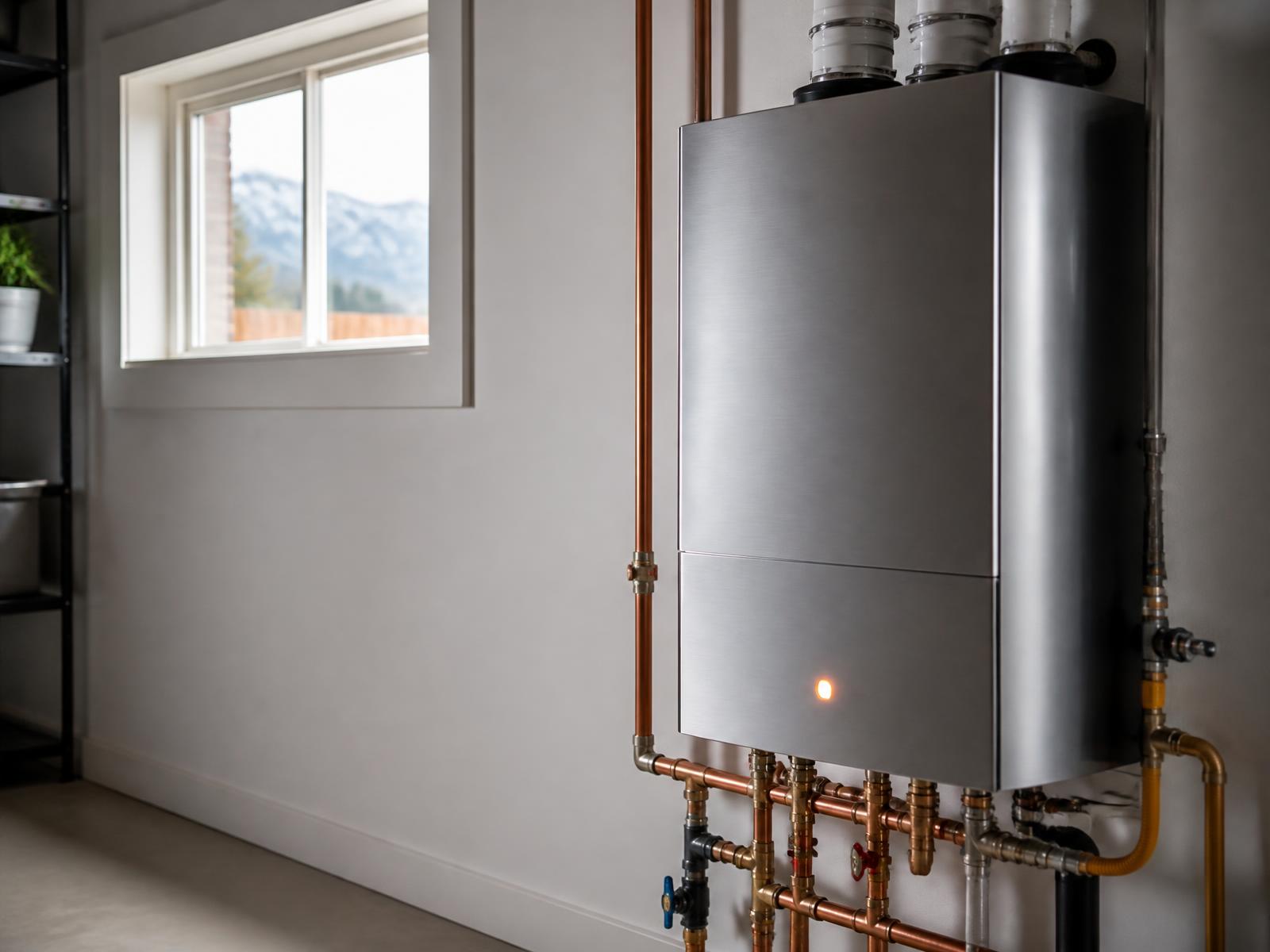
Tankless Water Heaters and Aurora's Altitude
A tankless water heater sized off a manufacturer's sea-level chart will underperform in Aurora. At roughly 5,470 feet, gas combustion appliances lose usable BTU output as elevation increases, and most tankless manufacturers publish an explicit altitude derating table for exactly this reason. Skip that step and a unit that looks perfectly sized on paper runs out of capacity the first time two showers and a dishwasher run at once on a January morning.
The second variable most installers overlook is incoming water temperature. Aurora's groundwater drops into the low 40s°F during winter, which is a far bigger temperature rise for the unit to deliver than the 60°F+ baseline used in a lot of generic online sizing calculators. We size every tankless installation against Aurora's actual winter inlet temperature and altitude-derated BTU output, not marketing numbers, so the unit performs on the coldest day of the year, not just the mild ones.
We also account for what's actually in the water. Aurora Water treats and delivers a clean, well-regulated supply sourced from the South Platte, Colorado River and Arkansas River basins through the Prairie Waters Project and the Peter D. Binney Purification Facility — but it carries enough hardness that tankless heat exchangers need annual descaling to stay at rated capacity. That's built into how we install and support every unit, not sold as an afterthought.
Tankless Water Heaters, Correctly Sized for Aurora Homes
Tankless water heaters heat water on demand as it flows through a compact heat exchanger, rather than storing 40–75 gallons at temperature around the clock. Done right, that means an endless supply of hot water, lower standby energy loss, and a unit that can last 18–20 years instead of the 10–12 years typical of a standard tank — but only if the sizing, venting and gas supply are correct from day one.
We install both condensing and non-condensing gas tankless units as well as electric tankless models for smaller point-of-use applications, and we walk every Aurora homeowner through which category fits their home's gas capacity, venting path and hot water demand before recommending a specific unit.
Altitude-derated sizing
BTU output calculated against Aurora's actual elevation, not a sea-level spec sheet number.
Winter inlet temperature
Flow-rate sizing run against low-40s°F winter water, the true worst-case demand.
Full code compliance
Gas line, venting and combustion air sized to current fuel gas code and City of Aurora permit requirements.
Common Tankless Water Heater Problems in Aurora
Most tankless complaints we get called out for trace back to sizing or installation shortcuts made by someone unfamiliar with Aurora's elevation and water conditions.
Undersized for elevation
A unit rated at sea level for a given household is running noticeably below that capacity here, leading to lukewarm water when demand spikes.
Cold water sandwich
A brief burst of cold water between hot water draws, usually from a unit sized too tight for simultaneous fixture use or a recirculation system that wasn't configured correctly.
Scale-clogged heat exchanger
Missed annual descaling lets hard-water mineral deposits build up inside the heat exchanger, cutting flow and triggering high-limit error codes.
Undersized gas line
Tankless units draw far more gas on demand than a tank unit; a gas line sized for the old tank often can't deliver enough volume for the new unit's burner.
Improper venting
Venting installed with the wrong material, slope or termination clearance for the unit's higher exhaust temperature, which can trip safety shutoffs or fail inspection.
Frozen or blocked exterior vent
Condensing units vent through a wall termination that can ice over or get blocked by snowdrift during a hard Colorado winter, shutting the unit down.
Signs Your Tankless Unit Needs Service
A tankless unit rarely fails without giving warning. These are the signs Aurora homeowners call us about most.
- Water temperature fluctuates between hot and lukewarm during a single shower
- Unit displays an error code on its digital readout
- Noticeably reduced flow rate at fixtures
- Delayed hot water arrival that's gotten longer over time
- Popping, ticking or rumbling sounds from the unit
- Visible scale or mineral buildup at the unit's water connections
- Unit shuts off mid-use, especially when multiple fixtures run at once
- Higher gas bills without a change in hot water usage
Why Tankless Units Underperform in Aurora Homes
Understanding why a tankless system underperforms usually points straight back to a decision made at installation.
Sizing chart never adjusted for altitude
Many installers use the manufacturer's flat BTU rating without applying the elevation derate that Aurora's 5,470-foot altitude requires.
Skipped descaling
Aurora Water's supply is clean but moderately hard, and a tankless heat exchanger without an annual flush accumulates scale year over year.
Gas meter or line undersized
A home's existing gas meter or line, adequate for a 40,000 BTU tank, often can't supply the 150,000–199,000 BTU a tankless unit demands under load.
Vent run too long or improperly sloped
Manufacturer maximum vent lengths and slope requirements get exceeded on longer runs through older homes, causing condensate pooling or exhaust backpressure.
No isolation valves installed
Without dedicated service valves, descaling and maintenance become far more invasive and expensive than they should be.
Recirculation added without a matched unit
Retrofitting a recirculation loop onto a tankless unit not designed or configured for it causes the cold-water-sandwich effect at fixtures.
How We Size and Install Tankless Water Heaters
Every tankless installation we perform starts with sizing math specific to your home, not a generic recommendation.
Altitude & flow-rate sizing
We calculate BTU requirements against Aurora's elevation and winter inlet temperature, then match a unit's certified output to your home's actual fixture count.
Gas line evaluation & upsizing
We verify your gas meter and line can supply the new unit's peak demand, and resize the line when it can't.
Code-compliant venting
Vent material, length, slope and termination clearance installed to manufacturer spec and current mechanical code.
Isolation valve kit
Dedicated service valves installed with every unit so annual descaling takes under an hour instead of disconnecting plumbing.
Condensing unit upgrades
Higher-efficiency condensing units where venting or fuel costs make the added upfront cost pay back faster.
Point-of-use electric tankless
Small electric tankless units for a remote bathroom, guest suite or accessory dwelling where running gas isn't practical.
Tankless vs. Tank: What Fits Your Aurora Home
Tankless isn't automatically the right upgrade for every household. Here's how we help homeowners decide.
Tankless makes sense when
- Your household regularly runs out of hot water with a standard tank
- You want the longest realistic service life from a water heater investment
- Space is tight and freeing up a utility closet or basement footprint matters
- Your gas meter and line can support the higher BTU draw, or upsizing is straightforward
- You're building new or already doing a larger remodel that includes plumbing work
A tank replacement is often the better call when
- Your existing gas line and venting would need significant, costly upgrades for tankless
- You want the lowest upfront cost and don't run out of hot water today
- Your household hot water demand is modest and consistent, not peaky
- You're in a home you don't plan to stay in long enough to recoup the tankless premium
- You want a simpler system with fewer components to service
Our rule of thumb
Our Tankless Installation Process
Here's what a tankless installation with our team actually looks like, start to finish.
- 1
In-home evaluation
We check your existing gas line size, venting path, water pressure and fixture count to determine what the home can support.
- 2
Altitude-corrected sizing
We calculate the required BTU output and flow rate against Aurora's elevation and winter inlet temperature, then recommend specific units.
- 3
Written, upfront quote
A single price covering the unit, any gas or vent upgrades, isolation valves, permit fees and disposal of the old equipment — no surprises after the wall is opened.
- 4
Gas & vent work
Gas line resizing and new venting installed to manufacturer spec and current mechanical code where needed.
- 5
Installation & startup
Unit mounted, connected, isolation valves installed, and combustion and flow verified at startup.
- 6
Permit inspection & walkthrough
We schedule the City of Aurora Building Division inspection and walk you through the unit's controls, error codes and descaling schedule.
Tankless Water Heater Cost in Aurora
Realistic tankless pricing for the Aurora market, based on the work each installation type actually requires.
| Scope of work | Typical range |
|---|---|
Like-for-like tankless replacement Existing gas line and venting already adequate; unit swap and permit inspection only. | $3,200 – $4,800 |
Tank-to-tankless conversion Includes new venting, gas line resizing and isolation valve kit in most cases. | $4,800 – $6,500 |
Condensing tankless upgrade Higher-efficiency unit with PVC venting; often lower installation cost offset by unit price. | $4,500 – $7,200 |
Gas line upsizing Depends on run length, whether it's exposed or requires wall/floor access. | $450 – $1,400 |
Point-of-use electric tankless For a single remote fixture or small accessory space; no gas venting required. | $650 – $1,400 |
Annual descaling service Recommended yearly given Aurora Water's hardness; keeps warranty intact. | $150 – $225 |
Why the range is a range
- City of Aurora permit and inspection fees are included in our written quote, not added afterward.
- Gas line and venting scope is confirmed during the in-home evaluation, before any work starts.
- Financing is available for homeowners spreading the cost of a larger conversion.
- We remove and dispose of the old water heater as part of every installation.
Benefits of Going Tankless in Aurora
A correctly sized tankless system delivers real, measurable advantages over a standard tank.
Endless hot water
No more running out mid-shower with a full house of guests or back-to-back showers on a school morning.
18–20 year service life
Roughly double the lifespan of a standard tank, when annual descaling is kept up.
20–30% lower water heating costs
No standing pilot or tank reheating losses translates to a real reduction in gas usage for most households.
Reclaimed utility space
A wall-mounted unit frees up floor space a 50-gallon tank used to occupy in a closet, basement or garage.
Tankless Water Heater Maintenance for Hard Water
Tankless units need less maintenance than a tank overall, but the maintenance they do need is non-negotiable given Aurora's water hardness.
The single most important thing an Aurora tankless owner can do is descale the heat exchanger annually. Aurora Water's supply, while clean and well-treated, carries enough mineral hardness that scale accumulates on tankless heat exchanger surfaces noticeably faster than in a standard tank. Left unaddressed, scale reduces flow rate, raises exhaust temperature, and shortens the unit's service life by years.
Beyond descaling, we recommend an annual visual inspection of the venting for blockage or ice, a check of the inlet water filter screen, and verification that the combustion air supply hasn't been obstructed by storage or renovation work. All three are quick checks included in our annual maintenance visit.
- Descale the heat exchanger annually with isolation valves
- Inspect and clean the inlet water filter screen
- Check vent termination for ice, snow or debris blockage each winter
- Verify combustion air intake is unobstructed
- Confirm error code history with the technician at each visit
- Test isolation valves for smooth operation
Tankless Water Heater FAQs for Aurora Homeowners
Related Water Heater Services
Water Heater Repair
Diagnostic and repair service for tank and tankless water heaters throughout Aurora.
Read moreWater Heater Replacement
Full tank water heater replacement, sized correctly for your household and altitude.
Read moreEmergency Water Heater Repair
Same-day emergency response for leaks, no-hot-water calls and gas safety issues.
Read moreWater Heater Maintenance
Annual tank flushes, anode inspections and tankless descaling plans built for Aurora's hard water.
Read moreReady for a tankless system that's actually sized right?
Call (720) 644-8755 for a straight answer on whether tankless makes sense for your home, and an upfront, written quote before any work starts.